
"States with lax gun laws are safer than states with strict gun laws"

The title quote—"States with lax gun laws are safer than states with restrictive gun laws"—was shared with me at a local dog park by an acquaintance I’ll call Jeremy (not his real name).
I want to approach this comment carefully. My hope is that if Jeremy reads this post, he’ll recognize that I’ve made a genuine effort to consider his perspective in good faith. I also value the possibility of an open, trusting dialogue with him. We likely see this issue very differently, but it’s rare these days to have civil conversations across political divides—and I’d like to make the most of that opportunity.

Disclaimer: I grant the possibility that my memory of the conversation may not be 100% accurate, but to the best of my ability, I aim to convey with fidelity how I experienced and understood the conversation.
The Conversation
To make sure I understood Jeremy correctly, I asked:
"You mean like Indiana is safer than Illinois?"
He confirmed that was what he meant. As supporting evidence, he explained that you don’t hear about riots in states with lax gun laws. He added that because nearly everyone owns a gun—or at least assumes others do—people are deterred from bad behavior, since they risk being shot. (I’m paraphrasing here, as I don’t recall his exact words.)
At that point, I tried to shift the conversation away from discussing gun rights to some simple response:
"I really don't want to live in a world where I'm required to be armed to feel safe, I'd rather delegate violence to trusted peers for safety."
Why Didn’t I Engage Jeremy Right Then?
I recognized that Jeremy was presenting his opinion as fact. He could have phrased it differently, for example:
"I think states with lax gun laws are safer than states with restrictive gun laws."
That wording would have invited me to explore why he holds that view.
To be fair, it’s reasonable to interpret his comment as opinion—he immediately offered supporting points about riots and deterrence. Still, I don’t know him well enough to launch into a debate over why he believes what he does. That leaves me wondering how, or even whether, I could persuade him to see things differently.
I’m sure Jeremy and I would agree that if I tossed our dogs’ tennis ball into the air, it would fall back to the ground. That truth is indisputable, even if we don’t fully grasp the mechanics of gravity. But claims about whether lax or restrictive gun laws make states safer aren’t so easily proven in the moment. They require data, studies, and interpretation.
And if I had reached for that kind of evidence, the conversation likely would have veered toward accusations of biased information sources. That’s a quick path to confrontation—and I feared it wouldn’t be productive.
Potential Misunderstandings
Safety:
What exactly does Jeremy mean by “safe”?
When I hear “safety” in this context, I think of the likelihood of injury or death by gunfire. That includes accidents, suicides, domestic disputes, premeditated murders, and mass shootings—safety doesn’t distinguish between these scenarios. From my perspective, states with lax gun laws increase the likelihood of injury or death from any of them.
If Jeremy’s definition of safety is limited to the absence of riots—since that was the first example he gave—I’d see that as a troublingly narrow way to define it.
State:
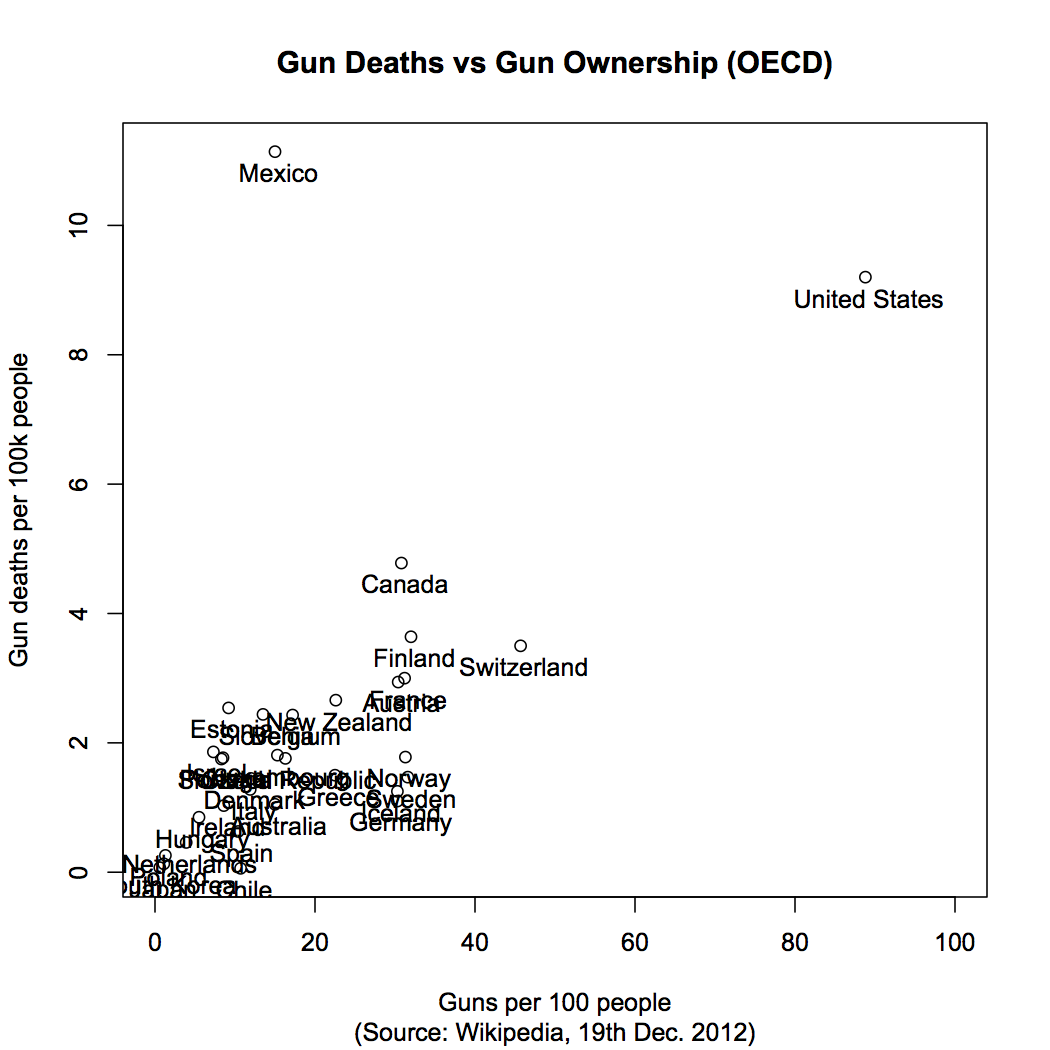
When Jeremy says “states,” I’m sure he doesn’t mean nation-states. Yet one of the most striking charts I’ve seen compares gun deaths to gun ownership across countries. The United States is an extreme outlier—not only in gun deaths (alongside Mexico) but also in guns per 100 people.
 |
| From https://mark.reid.name/blog/gun-deaths-vs-gun-ownership.html |
Reid's analysis is intentionally basic, and he acknowledges its limits, but he also points to more rigorous studies that reach the same conclusion: the U.S. is an outlier. This may be beyond the scope of a casual conversation with Jeremy, but if the goal is to talk meaningfully about “safety,” I don’t see why we should restrict ourselves only to data within U.S. borders.
States vs Regions
When Jeremy makes his claim, does he take into account that a city like Chicago can’t fully realize the benefits of restrictive gun laws if neighboring states maintain very lax ones? The regional landscape matters: a state’s efforts can be undermined by what happens just across its borders. It has been reported that Indiana is a major source of guns later used in crimes that Illinois law aims to restrict. More broadly, the majority of guns recovered in Chicago originate from out of state.
This dynamic is why many argue for federal gun legislation—without it, state-level restrictions are weakened by the ease of simply crossing a border.
Where is it dangerous?
But is Chicago even really the scariest-- most murder prone-- city out there? If we use murder rates as the measure of "safety", can we honestly conclude that states with lax gun laws are safer?
Here are the states that contain the top cities for murder rates, along with their rating for gun law strictness:
- Louisiana (38th)
- Tennessee (32nd)
- Missouri (48th)
- Maryland (8th)
- Washington DC (N/A)
- Alabama (34th)
- Pennsylvania (16th)
- Virginia (14th)
- Indiana (27th)
- Wisconsin (22nd)
- Kentucky (47th)
- Ohio (26th)
- Michigan (17th)
Recently I heard a quote that resonated with me and feels particularly relevant to my feelings about Jeremy's statement:
Walter Lippmann, a century ago, in his book Liberty and the News, wrote, “The really important thing is to try and make opinion increasingly responsible to the facts. There can be no liberty for a community which lacks the information by which to detect lies.” Thank you to The David Frum Show for surfacing this quote to me.
With that in mind, I’d genuinely like to see evidence that lax gun laws lead to greater safety. To seek out this evidence, I hoped I would get some leads from asking chatGPT:

If I'm being honest, I was surprised that chatGPT had nothing to offer and generally refuted what I was seeking. But I pressed on and got some leads:
- Lead 1: Are strict gun laws making people safer? --from ConcealedCarry.com by Matthew Maruster
- ConcealedCarry.com describes itself on its website as:
- "a resource for American Concealed Carriers. We operate a network of firearm instructors across the country, an online store of firearm accessories, and act as a media outlet for the firearm industry."
- "[existing] to empower and prepare 1 million gun owners to act as Guardians or citizens that are prepared and willing to protect the innocent in our society from the criminals, predators, and terrorists that would feed on our communities."
- "...[believing] that in this society everyone is safer and better prepared by obtaining as much education, training, and knowledge as possible."
- His article frames the debate in familiar terms: "Some people argue that states with stricter gun laws are more dangerous, while others claim that these laws make communities safer. So, which is it? Myth or fact?"
- In the end he concludes: "...my point of writing this isn't to persuade you one way or another. Instead, I hope people on both sides of the argument will critically think about how they cite statistics in arguing their side..."
- He admits that he "clearly [has] an opinion on the topic." and we can assume it is in favor of lax gun laws considering he is writing for concealedcarry.com.
- I accept some of his points:
- "...fewer guns DO equal fewer deaths where a firearm is involved. However, it isn't entirely because there is less crime."
- He notes that the gun control lobby focuses on gun deaths, which naturally rise where guns are more available. To him, this seems obvious—almost not worth getting worked up about.
- At one point he broadens the frame: "wouldn't it be better to link it to the rate of violent crime rather than any death related to a firearm?"
- To me, this misses the point. The prevalence of guns increases the likelihood that any violent encounter—or even an accident—ends in grievous injury or death. Safety isn’t just about crime statistics. It also includes:
- A child who dies from finding or mishandling a gun.
- A person, in a temporary crisis committing suicide.
- On the suicide point in particular: firearms are overwhelmingly the most lethal method as they "...were found to be the most lethal method (CFR:89.7%), followed by hanging/suffocation (84.5%), drowning (80.4%), gas poisoning (56.6%), jumping (46.7%), drug/liquid poisoning (8.0%) and cutting (4.0%)." -ScienceDirect.com
- And "justifiable homicide", as Matthew Maruster terms it.
- I take issue with this language because it implicitly encourages vigilantism, or at least license to defend ones self to mortal ends. I think we should be much more circumspect about how we nod to ideas of justice while stripping that justice of process and fairness. It is interesting to me that he would choose "justifiable homicide" as opposed to "self defense". 🤔
- Maruster eventually acknowledges that violent crime occurs in states with both strict and lax gun laws: "....violent crime is prevalent in states with lax gun laws, but it isn't exclusive to those states."
- This is my point! 🌟 Crime occurs anywhere and everywhere, but deaths and injuries from guns occur where more guns exist and are easier to obtain. Crimes, suicide attempts and accidents will happen, but ubiquity of guns makes those events more grievous.
- Matthew then makes an argument which he frames as in support of his viewpoint, but which I think actually weakens it. He says: "If gun laws were the most significant factor related to public safety, we should see it bear out here..." He's referring to a data table from Statista that ranks reported violent crime per capita and he points out how some of those states have strict gun laws, while others have lax ones. It allows him to conclude that "it underscores the presupposition that a state's crime rate is affected by much more than how strict or lenient their gun laws are." Said another way, gun laws are not the only factor in determining whether a state is safer or more dangerous with regards to violent crime.
- Again, see my last aside, that crimes, suicides and accidents will happen anywhere-- the gun laws don't change that fact. It's just that easy access to guns results in those events being more tragic more often.
- 🤯. Why can't he just take a strong opinion and finish it out with "...just let everyone arm themselves anyway."? I have some guesses about why, but that is for another discussion.
- Lead 2: John Lott
- So who is he?
- A thorough profile of him appears at TheTrace.com which describes itself on its website as
- "a team of journalists exclusively dedicated to reporting on our country’s gun violence crisis."
- "[being] committed to transparency in every aspect of our funding."
- "maintaining a firewall between our news coverage decisions and all sources of revenue."
- The profile sketches Lott as follows:
- Core Claim: Lott’s 1998 book More Guns, Less Crime argues that looser gun laws (esp. concealed carry) make society safer by deterring crime.
- Influence: His research underpins much of modern gun-rights rhetoric, frequently cited by Republicans, the NRA, and judges striking down gun restrictions.
- Criticism: Most academics say his methods are flawed, his surveys unverifiable, and his results don’t hold up under replication.
- Controversies: Accused of cherry-picking data, misrepresenting results, and even using a pseudonym (“Mary Rosh”) to defend his work online.
- Current Role: Runs the Crime Prevention Research Center, still publishing and testifying, making him the most prominent promoter of the “looser gun laws = safer” narrative.
My viewpoint
- While people kill people, it is people with easy access to an abundance of guns that are more likely to cause death than people without. I think that me, my family and my community would be safer if...
- ...guns were scarcer.
- ...the kinds of guns available were limited.
- ...the requirements for purchasing and owning guns were stricter.
Comments
Post a Comment